
Review of NQ Academy Webinar #6: From Large-Scale Tectonics to Field-Scale Geothermal Systems
Wednesday, March 3, 2021
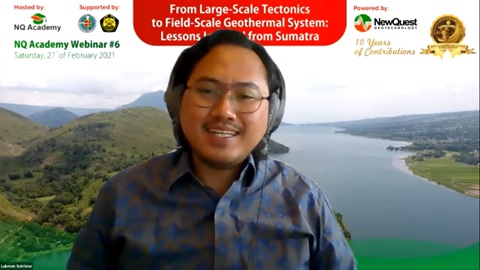
NQ Academy Webinar #6 has been held on February 27, 2021. The webinar was presented by Dr. (cand) Lukman Sutrisno, a Ph.D. candidate in Tectonics & Geothermal on Joint Supervision Ph.D Program between Utrecht University (Netherland) and Universitas Indonesia. The Webinar was hosted by Dr. Yunus Daud, Founder of NewQuest Geotechnology, and was discussing the topic of “From Large-Scale Tectonics to Field-Scale Geothermal System: Lessons Learned from Sumatra”. The 6th NQ Academy Webinar was well organized and attended by more than 150 participants.
The speaker use Sumatra as a case study and was discussing about two different things, those are the large scale tectonics with hundreds of kilometers spatial resolution and geothermal field scale with merely several kilometers size, and how the two phenomena were related?
Sumatra is a result from long live active margin (convergent movement repeatedly) begin from Paleozoic era (about 200-300 million years ago) until nowadays. This long live convergent movement affects the latest subduction, volcanism, and micro-continent plates of Sumatra. The convergent movement of Sumatra is an oblique convergence type which yield Sumatran Fault system (SFS).
In term of tectono-volcanic domains (TVD), the SFS is devided into 3 TVDs. The first TVD is the Northern TVD which is dominated by compressional/ transpressional system. The volcanism in this section are shifted to the Eastern part of the SFS. The second TVD is the Central TVD which has characteristics almost the same as the North TVD, but has more voluminous magmatism/ volcanism than the Northern section since it is associated with slab tearing. The third TVD is the Southern TVD which is dominated by strike slip deformation. In this area, the Volcanism and SFS are coexist.
Compared to geothermal system in Java, the Sumatran system is relatively different with Java system. In Sumatra often found the basement on the drilling process. Moreover, we can also found the basement outcroping on the surface. While the basement on the Java system is very deep. Even we drilled up to 3 km, the basement can not be found.
At the end of the presentation, the speaker concluded that there are associations between large-scale tectonic setting with field-scale geothermal systems. The speaker also showed the implication and resource risks of geothermal systems which are related to transtensional setting, tranpressional setting, and strike-strip fault. Each systems resulted in different characteristics in geothermal play, temperature, permeability, and lateral extent.