
WKP Tangkuban Perahu, Developing Geothermal in Volcano Tourism Location
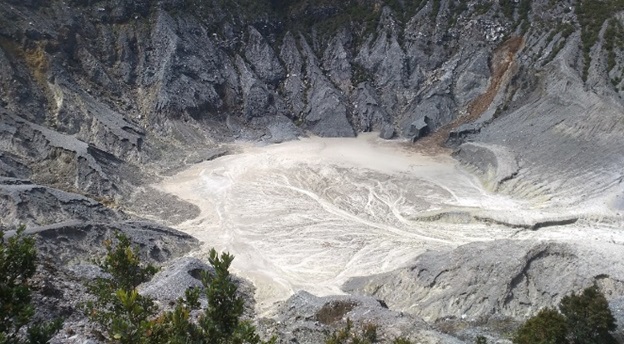
Mount Tangkuban Perahu is located in West Java Province between Bandung and Subang cities, among its manifestations are including craters, fumaroles, steaming ground, silica sinter, and hydrothermal alteration.
West Java is a province with the largest geothermal potential in Indonesia, which is around 5.4 GW, equivalent to 20% of the national potential. From 2.1 GW geothermal installed capacity, there are 1.2 GW which are produced in West Java from 7 fields, namely: Kamojang, Darajat, Awibengkok Salak, Wayang Windu, Patuha, and Karaha Bodas.
In 2017 the government assigned PLN to manage the Tangkuban Parahu WKP and was assigned the management to PLN.
PLN through NewQuest Geotechnology has just completed data and information enhancement activities, includes: Remote Sensing Analysis, Reprocessing and 3-D Modeling of Existing MT-Gravity Data, Geological Mapping and Rock Analysis, Geochemical Studies and Water/Gas/Isotope Analysis, Geophysical Survey (Gravity, MT, and TDEM), Conceptual Modeling and Resources Assessment, Well Targeting, Well Pad Selection, and Drilling Design, Infrastructure Design (Access Road, Well Pad, Water Distribution System), Power Plant Design (Process Flow Diagram, Technology Selection), FCRS Design, Transmission Line, Economic and Financial Evaluation.
Tangkuban Perahu with a potential of 100 MW will be developed 60 MW, COD target is on 2024 (RUPTL 2019). Tangkuban Perahu is one of the most popular volcano tourism areas in Indonesia with very easy and supportive access. Last activity of this Mountain is a phreatic eruption (hydrothermal eruption) recorded in July 2019 with a high ash column from the top of the mountain about 200 meters, or about 2,284 meters above sea level. Tangkuban Parahu’s visit rate is high with around 1.4 million tourists in 2018, 64,000 of whom are foreign tourists.
According to Indonesian Vulcanology (vsi.esdm.go.id), the Tangkuban Perahu eruption has always been classified as a minor eruption. Since erupting for the first time in 1829, it has only erupted steam/ hot water and ash without being followed by melting lava, hot clouds or throwing incandescent rock.
PLN will immediately appoint partners for the development of this WKP, while interested parties can form a consortium with selected partners.