Review of NQ Academy Webinar #5: Final Preparation of Government Drilling Program
Friday, February 5, 2021
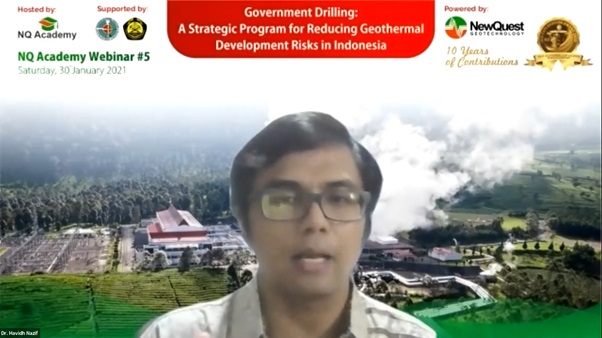
NQ Academy Webinar #5 has been held in collaboration with the Directorate General of New Renewable Energy and Energy Conservation (NREEC) – the Ministry of Energy and Mineral Resources on January 30, 2021. The webinar is presented by Director of Geothermal Energy at the Directorate General of NREEC with an interesting topic of “Government Drilling: A Strategic Program for Reducing Geothermal Development Risks in Indonesia”. The webinar is hosted by Dr. Yunus Daud, founder of NewQuest Geotechnogy.
It has been long planned, finally government to starts Government Drilling Program in the middle of this year at 2 WKPs: WKP Cisolok-Cisukarame, in West Java province and WKP Nage in East Nusa Tenggara (NTT) province. The exploration process will be carried out by the Geological Agency using the government budget, planned for 20 WKPs in the 2021-2024 period with total reserves 683 MW, mostly marginal area which is dominated by medium temperature geothermal system.
Dr. Havidh Nafiz, who represented the Director of Geothermal, started by conveying Government Drilling goals is to improve the quality of geoscience data and information before an area is offered to business entities. This condition will reduce development risks, increase the economics of geothermal projects and generate electricity at a more competitive price.
As Indonesia National Standard (SNI) No.6009/2017, exploration drilling is required to improve the classification of reserves from possible reserves to probable/ proven reserves by obtaining several data and information. The data and information related to confirm the conceptual model of the geothermal system through drilling through clay cap until it reaches the reservoir zone, direct measurement of reservoir temperature and direct measurement of reservoir fluid and/ or production test data.
The Government Drilling Program consist of several sub program: additional data acquisition, well targeting and peer review, land acquisition, infrastructure, and xploration drilling (2 slim hole wells + 1 standard hole well).
The drilling program will be conducted in 2 stages. The first stage is slim hole drilling which aim to reduce exploration risk in confirming reserves at lower cost and obtain subsurface information: lithology of rocks, alteration rocks, mineralogy, geological structures, etc. The second stage is standard hole drilling which has objective to obtain the geothermal fluid characteristics and it also expected to be used as production well. With performing this strategy, there is an opportunity to reduce exploration risks as well as cost efficiency by deciding “go/ no go” based on the first stage result of 2 slim well drilling are carried out.
At the end of the presentation, Dr. Havidh explained the Government Drilling activities in 2021 consist of additional geoscience data acquisition, well targeting, and peer review at 8 prospects, infrastructure preparation at 3 prospects as well as exploration drilling and well testing at Cisolok Cisukarame and Nage (2 slim holes/prospect).
Currently, the Geological Agency team is in the Cisolok and Nage for additional data acquisition and final preparations. In addition, the slim hole drilling contractor will be selected through tender mechanism. The main requirement to participate in a tender as a drilling contractor is to have a rig in Indonesia.
In the question and answer session, a participant asked if there are a WKP tender or PSPE assignment during the implementation of Government Drilling Program? Dr. Havidh answered, “It will be postponed, the MEMR will focus on Government drilling.”
NQ Webinar #5 attended by more than 100 audience from various countries like Japan, Australia, US, Peru, Iceland, India, Ireland, Saudi, Canada, New Zealand, and Malaysia.